The city
Czechoslovakia and the First Republic: twenty years of democracy in Prague
Tony Denesa – Travel Advisor10 min read
For Czechs, the First Republic — *první republika* — is a kind of golden age: twenty years between 1918 and 1938 when their country was independent, democratic, prosperous and modern, while dictatorships rose around it. The period shaped modern Prague, from its currency and architecture to its public holidays. It ended in betrayal and occupation, which only deepened the nostalgia.
The end of an empire
For three centuries the Czech lands had been ruled by the Habsburgs from Vienna. During the First World War, Czech exiles led by the philosopher and politician Tomáš Garrigue Masaryk, together with Edvard Beneš and the Slovak astronomer and general Milan Rastislav Štefánik, campaigned abroad for an independent state of Czechs and Slovaks.
Their strongest argument was the Czechoslovak Legions: tens of thousands of Czech and Slovak soldiers, many former prisoners of war, who fought on the Allied side in France, Italy and Russia. In Russia, the Legions famously took control of long stretches of the Trans-Siberian Railway during the civil war. Their story made the Allies take the Czechoslovak cause seriously.
28 October 1918
On 18 October 1918, Masaryk issued a declaration of independence in Washington. Ten days later, on 28 October, as Austria-Hungary collapsed, the National Committee in Prague proclaimed the independent Czechoslovak state. Crowds filled Wenceslas Square and tore Habsburg symbols from buildings. Two days later, Slovak representatives joined the new state.
Masaryk was elected president and returned to Prague in December 1918 to a hero's welcome. Štefánik died in a plane crash in 1919, and Beneš became foreign minister. 28 October is still the Czech national holiday.
The philosopher-president
Masaryk, often called simply "TGM" or "the President-Liberator", was re-elected three times and served until 1935. A former professor, he believed democracy was not just a system but a moral commitment, and he became a symbol of humane, liberal politics. He made Prague Castle the seat of a democratic head of state and invited the Slovenian architect Jože Plečnik to remodel its courtyards and gardens in a spirit of openness. His statue stands on Hradčany Square in front of the castle gates.
A new state, a new currency
The new republic moved quickly to separate itself from the chaos of post-war Central Europe. Finance minister Alois Rašín stamped the old Austro-Hungarian banknotes, withdrew part of the money in circulation and created the Czechoslovak koruna, one of the most stable currencies of the interwar years. Read the full story in the Czech koruna.
Industry and prosperity
Czechoslovakia inherited much of Austria-Hungary's industry, and between the wars it was among the most industrialised countries in Europe. The Škoda Works in Plzeň made machinery and weapons, Tatra built cars and aircraft, ČKD built locomotives and trams in Prague, and Baťa in Zlín became a world leader in shoes. Prague grew rapidly, with new districts, tram lines and suburbs such as Dejvice and Vršovice.
A modern culture
The First Republic was a time of extraordinary creativity:
- Karel Čapek wrote the play *R.U.R.* (1920), which gave the world the word robot, suggested by his brother Josef.
- Jaroslav Hašek published *The Good Soldier Švejk*, the great comic novel of the war.
- Franz Kafka wrote in German in Prague until his death in 1924.
- The avant-garde group Devětsil brought together poets, painters and architects, while Voskovec, Werich and the composer Jaroslav Ježek filled the Liberated Theatre with jazz and satire. See music in Prague.
- The Barrandov film studios opened in the 1930s.
Modern architecture
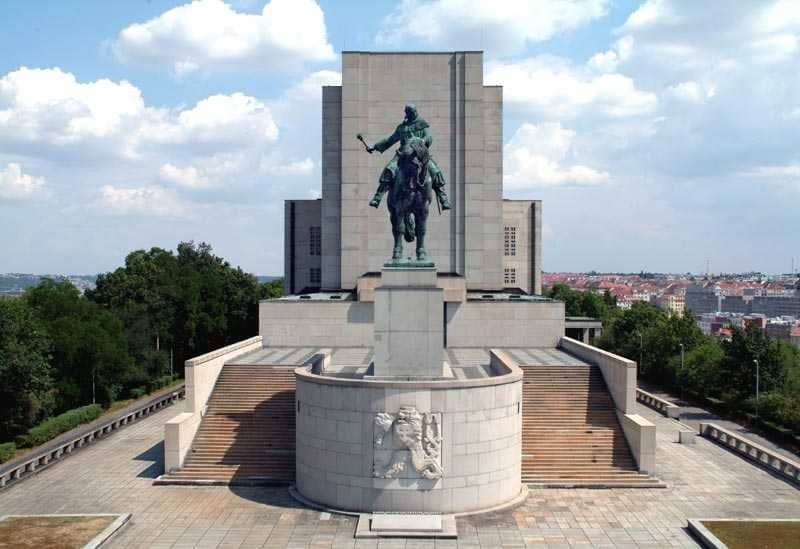
Prague became a showcase of functionalism. The vast Trade Fair Palace in Holešovice, Adolf Loos's Müller Villa, and the model villa estate of Baba in Dejvice are its landmarks. On Vítkov hill, a monumental National Memorial was built in the 1920s and 1930s to honour the Legions — later taken over, ironically, by the communist regime. Read more in Prague architecture.
Tensions within
The republic was not a nation-state of Czechs alone. Of around 13.6 million inhabitants at the 1921 census, more than three million were Germans, living mainly in the border regions, along with Slovaks, Hungarians, Ruthenians, Poles and a large Jewish community. Minority rights were better than in most of Europe, but many Germans and Slovaks felt the state was run from Prague for Czechs.
The Great Depression hit the German-speaking border regions hard, and in the 1930s many voted for Konrad Henlein's Sudeten German Party, which increasingly took orders from Hitler.
Munich and the end
In September 1938, at Munich, Britain, France and Italy agreed to Hitler's demand that Czechoslovakia hand over its border regions, the Sudetenland, to Germany — without Czechoslovakia at the table. Abandoned by its allies, the government accepted. Beneš, president since Masaryk's retirement, resigned and went into exile. Czechs still call Munich *the betrayal*.
On 15 March 1939, German troops occupied the rest of Bohemia and Moravia, and Hitler spent the night at Prague Castle. On 17 November 1939, after student protests, the Nazis closed Czech universities, executed student leaders and sent more than a thousand to concentration camps — the date that students commemorated in 1989. See 1968 and 1989.
The legacy
After the war and the communist takeover of 1948, the memory of the First Republic was suppressed, and Masaryk's name was removed from streets and schools. After 1989, it returned: his statues were re-erected, 28 October regained its full meaning as Independence Day, and the First Republic became a reference point for Czech democracy. For the decades between, read communism in Prague.
Where to see the First Republic in Prague
- Prague Castle — Plečnik's courtyards and gardens, and Masaryk's statue on Hradčany Square.
- The Trade Fair Palace — functionalism and the National Gallery's modern collection.
- Vítkov — the National Memorial and its view over the city.
- Wenceslas Square — where independence was celebrated in 1918.
- The National Technical Museum — Tatra cars and aircraft of the era.
Plan a day around it with the itinerary builder and the museums guide.
Where to stay nearby
Live prices and availability on a map centred on this exact spot — hotels, apartments and hostels, so you can judge the walk from here rather than guess from an address.
Bookings made through this map earn us a commission. Your price is unaffected.