The city
The Czech koruna: the crown that survived two splits and stayed out of the euro
Tony Denesa – Travel Advisor8 min read
Every visitor to Prague handles it within minutes of arriving, and many wonder why a member of the European Union still uses its own money. The Czech koruna — *koruna česká*, written Kč or CZK — means "crown", and its history follows the dramatic twentieth century of the country itself. For practical money advice, see money and payments.
From the Austrian crown to Czechoslovakia
Before 1918 the Czech lands were part of Austria-Hungary, and people paid in the Austro-Hungarian krone. When Czechoslovakia declared independence in October 1918, it inherited that currency — along with the war debts and inflation that were ruining its neighbours.
The new state's first finance minister, Alois Rašín, acted fast. In early 1919 the borders were closed, banknotes in circulation were stamped to mark them as Czechoslovak, and part of each person's money was held back. It was harsh, but it separated the new Czechoslovak koruna from the collapse of the Austrian and Hungarian currencies, and the koruna became one of the most stable currencies in Central Europe between the wars. Rašín paid a price: he was shot by a young anarchist in 1923 and died of his wounds.
Occupation, communism and the 1953 reform
During the Nazi occupation the currency was split and subordinated to the German mark. After the war, the koruna was restored, but in 1948 the communists took power, and in 1953 they carried out a currency reform that wiped out most people's savings overnight. It sparked protests, most famously in Plzeň, which were put down by force.
For the next four decades the koruna was not freely convertible. Tourists had to exchange a minimum amount per day at an official rate, while a black market in Western currency flourished on the streets — the origin of the "exchange" scams that still survive in a different form today.
1993: two countries, two crowns
When Czechoslovakia peacefully split into the Czech Republic and Slovakia on 1 January 1993, the shared currency lasted only weeks. In February 1993, the old Czechoslovak banknotes were marked with stamps to show which country they belonged to, and new Czech koruna notes and coins soon replaced them. The Czech National Bank has issued the currency ever since. Slovakia later adopted the euro; the Czech Republic did not.
Why not the euro?
When it joined the EU in 2004, the Czech Republic committed in principle to adopting the euro one day, but no date has ever been set. Successive governments and much of the public have preferred to keep monetary independence. In practice, many hotels and some shops in the centre accept euros, but usually at a poor rate — paying in koruna, or by card in koruna, is almost always better.
The banknotes and who is on them
The current banknotes are a small gallery of Czech history, as described by the Czech National Bank, the source for this section:
- 100 Kč — Emperor Charles IV, founder of the New Town and Charles University. See Charles Bridge, his most famous monument.
- 200 Kč — Jan Amos Komenský (Comenius), the seventeenth-century educator.
- 500 Kč — Božena Němcová, author of *The Grandmother*, the classic of Czech literature.
- 1,000 Kč — František Palacký, historian and "father of the nation" of the nineteenth-century revival.
- 2,000 Kč — Ema Destinnová, the soprano who sang at the Metropolitan Opera alongside Caruso.
- 5,000 Kč — Tomáš Garrigue Masaryk, the first president of Czechoslovakia.
Coins come in 1, 2, 5, 10, 20 and 50 koruna. The smaller *haléř* coins were withdrawn years ago, so prices are rounded when you pay in cash.
Using the koruna as a visitor
- Pay by card almost everywhere; contactless is standard, even in many pubs.
- Always choose to pay in koruna when a card machine or ATM offers to charge you in your home currency. The "conversion" is usually far worse than your bank's rate.
- Avoid street exchangers and offices advertising "0% commission" with a large rate in small print. Nobody on the street offering to change money is doing you a favour.
- Use bank ATMs rather than the stand-alone cash machines in tourist streets, which often charge high fees.
- Know the prices. Our prices page lists checked prices for transport, sights and food.
A crown with a story
The koruna has outlived an empire, an occupation, a communist confiscation and the split of the country that created it. Whether it survives the euro is a debate for the future. For now, when you pay for a half-litre in a beer hall or a ticket to the Castle, you are holding a century of Czech history.
For more on the twentieth century behind it, read communism in Prague, and to plan your budget, see is Prague expensive? and the itinerary builder.
Where the money story is told
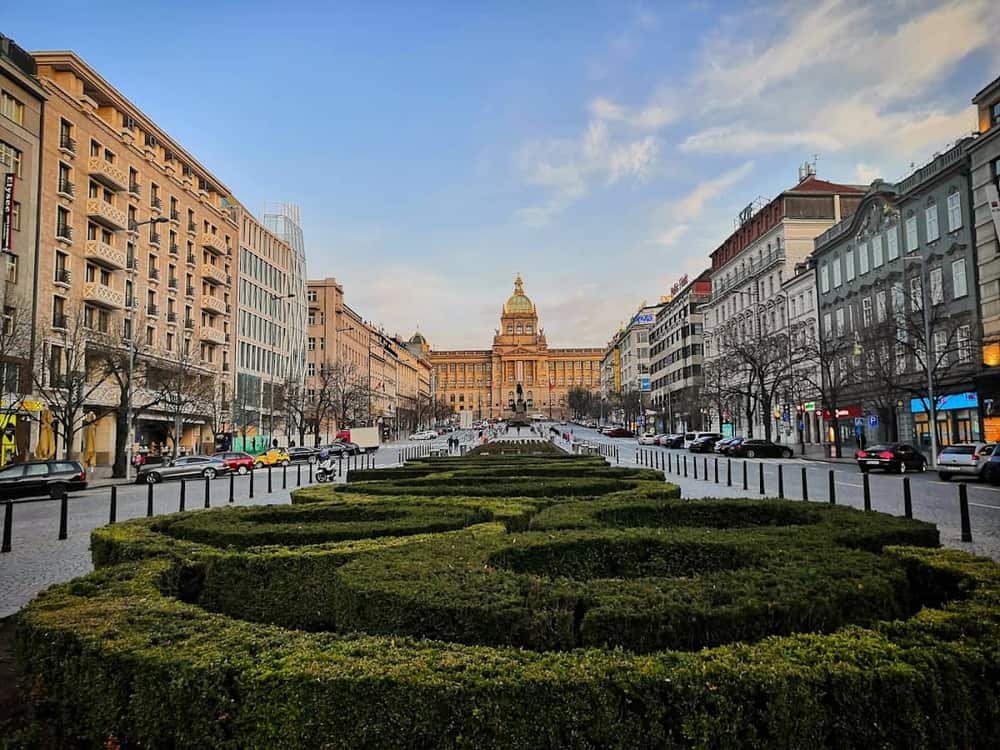
- The Czech National Bank runs an exhibition on the history of money in its headquarters near Wenceslas Square; check its site for opening times and booking.
- The National Museum covers the twentieth century that shaped the currency.
- Old Town Square saw the 1919 independence celebrations and the Communist takeover of 1948 — read the story in our Old Town district guide.
- The Museum of Communism and other museums show what everyday life and shopping looked like when the koruna could not be exchanged freely.
Where to stay nearby
Live prices and availability on a map centred on this exact spot — hotels, apartments and hostels, so you can judge the walk from here rather than guess from an address.
Bookings made through this map earn us a commission. Your price is unaffected.