
The city
Charles IV and medieval Prague: the emperor who built a capital
Tony Denesa – Travel Advisor10 min read
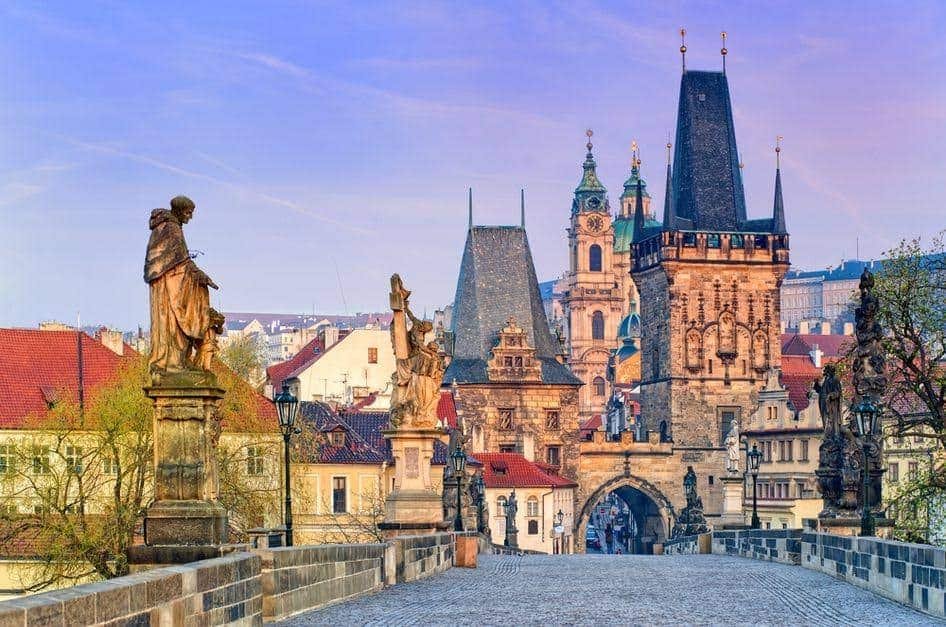
Walk across Charles Bridge, look up at St. Vitus Cathedral, cross Charles Square in the New Town or pass through the gates of Charles University, and you are walking through the vision of one man. Charles IV, King of Bohemia and Holy Roman Emperor, is the most important ruler in Czech history and the builder of medieval Prague. Czechs voted him the greatest Czech of all time, and his portrait is on the 100-koruna note — see the Czech koruna.
A prince raised in Paris
Charles was born in Prague in 1316 and baptised Václav (Wenceslas). His father, John of Luxembourg, was King of Bohemia; his mother, Elizabeth, was a princess of the Přemyslid dynasty that had ruled the Czech lands for four centuries. As a boy he was sent to the French royal court in Paris, where he took the name Charles after his godfather, the French king, and received an exceptional education. He spoke and wrote five languages.
Returning to Bohemia as a young man, he found Prague Castle in ruins and set about restoring the kingdom. He became King of Bohemia in 1346, after his blind father was killed fighting at the Battle of Crécy, and was crowned Holy Roman Emperor in Rome in 1355. For the rest of his reign, Prague was the capital of the empire.
A city for an empire
Charles wanted Prague to rival Rome, Paris and Constantinople. In just a few decades he transformed it:
- 1344 — Prague became an archbishopric, and work began on the new Gothic St. Vitus Cathedral at Prague Castle.
- 1348 — he founded Charles University, the first university in Central Europe, and the New Town, one of the largest planned urban extensions of medieval Europe, with vast market squares and wide streets.
- 1348 — he began building Karlštejn Castle to guard the imperial crown jewels and holy relics.
- 1357 — the foundation stone of the new stone bridge over the Vltava was laid.
The New Town
The New Town doubled the size of Prague. Charles laid it out around three great markets: the cattle market, now Charles Square; the horse market, now Wenceslas Square; and the hay market, now Senovážné náměstí. He invited craftsmen and traders with tax privileges and founded monasteries and churches across the district, including the Emmaus Monastery, where monks used the Old Church Slavonic liturgy. The scale of his plan still shapes traffic in central Prague today.
Peter Parler and the Gothic cathedral
To build his cathedral, Charles brought Peter Parler, a young architect from a family of master builders in southern Germany. Parler was a genius of late Gothic architecture: his net vaults, his flying buttresses and the Chapel of St. Wenceslas, its walls set with semi-precious stones, made St. Vitus one of the most innovative buildings of its time. The cathedral was only completed in the twentieth century, but its choir is the work of Charles and Parler.
Parler also designed the stone bridge and its magnificent Old Town Bridge Tower, decorated with statues of Charles, his son Wenceslas IV and St. Vitus.
Charles Bridge
The old Judith Bridge had been swept away by a flood in 1342. According to tradition, the foundation stone of its replacement was laid on 9 July 1357 at 5:31 a.m., a moment chosen by astrologers because the numbers form a palindrome: 1357 9 7 5 31. Whether or not the story is exact, it is one of the most beloved in Prague. Legend also says egg yolks were mixed into the mortar to strengthen it.
The bridge was simply called the Stone Bridge for centuries; it took the name Charles Bridge only in the nineteenth century. The Baroque statues that line it today were added much later, from the end of the seventeenth century. Read more about the river in the Vltava in Prague.
Karlštejn and the crown jewels
About thirty kilometres south-west of Prague, Karlštejn Castle was built as a treasury for the imperial regalia and Charles's collection of relics. Its Chapel of the Holy Cross, lined with gold, gems and more than a hundred panel paintings by Master Theodoric, was the spiritual heart of his empire. Visit it on a day trip to Karlštejn.
The Golden Bull and the Hunger Wall
In 1356, Charles issued the Golden Bull, a constitutional document that fixed how the Holy Roman Emperor was elected and confirmed the King of Bohemia as one of the seven electors. It shaped the empire for four centuries.
On Petřín hill, a medieval fortification wall runs down through the woods. It is known as the Hunger Wall, from a later legend that Charles built it in the 1360s to give work and food to the poor during a famine. Historians see it mainly as a defensive wall, but the name has stuck.
His death and legacy
Charles IV died in Prague Castle in 1378 and is buried in the royal crypt of St. Vitus Cathedral. His son Wenceslas IV could not hold his achievements together; within a generation, religious conflict led to the Hussite Wars. But the city Charles built survived: the university, the New Town, the cathedral and the bridge are still the frame of Prague.
Walking through Charles's Prague
- Start at the Old Town Bridge Tower and cross Charles Bridge early in the morning.
- Climb through Malá Strana to Prague Castle and the Gothic choir of St. Vitus, with the Chapel of St. Wenceslas.
- Return to the right bank and walk from the Old Town through the New Town to Charles Square and the Emmaus Monastery.
- On another day, take the train to Karlštejn.
Build it into your trip with the itinerary builder, and read on about the next great age of Prague in Rudolf II and the alchemists.
Where to stay nearby
Live prices and availability on a map centred on this exact spot — hotels, apartments and hostels, so you can judge the walk from here rather than guess from an address.
Bookings made through this map earn us a commission. Your price is unaffected.