The city
Jewish Prague: a thousand years of the Jewish Town
Tony Denesa – Travel Advisor10 min read
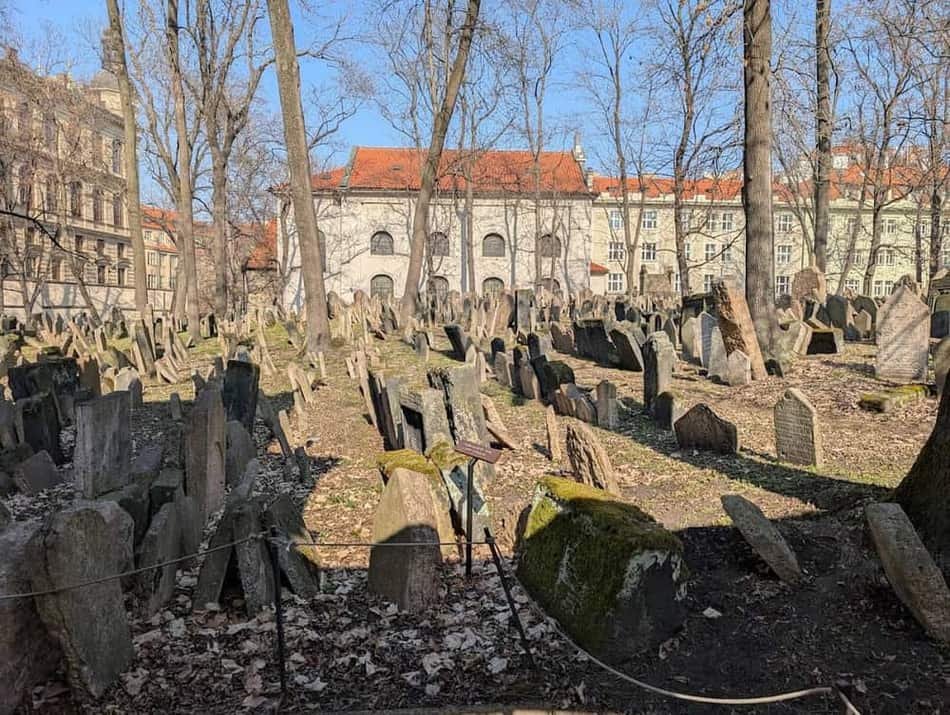
Between Old Town Square and the Vltava lies one of the most important sites of Jewish history in Europe. The synagogues and the Old Jewish Cemetery of Josefov survived when so much else did not, and they tell a story that runs for a thousand years. For practical advice on visiting, see Jewish Quarter tickets; this page is about the history.
The first Jewish merchants
Jews lived in Prague almost from the city's beginnings. In the 960s, the traveller Ibrahim ibn Yaqub, a Jewish merchant from Muslim Spain, described Prague as a busy trading town where Jewish merchants came to buy and sell. Over the following centuries, Jewish communities settled near the castle and on the right bank, and by the thirteenth century they were concentrated in the area that became the Jewish Town, next to the Old Town.
The ghetto and its synagogue
Medieval Jewish life was precarious. Jews were legally the "servants of the royal chamber", protected by the king in return for taxes, but excluded from most trades and from owning land outside their quarter. The Jewish Town became a walled ghetto, its gates closed at night.
In the late thirteenth century the community built the Old-New Synagogue, a Gothic hall with a steep brick gable. It is the oldest active synagogue in Europe and still used for prayer today.
Violence came in waves. At Easter 1389, a mob attacked the ghetto and killed a large part of the community — a massacre remembered in a lament still recited in the Old-New Synagogue.
The golden age: Maisel and Rabbi Loew
The late sixteenth century, under Emperor Rudolf II, who moved his court to Prague, was a golden age. Mordecai Maisel, mayor of the Jewish Town and one of the richest men in Central Europe, financed the emperor and paid for paved streets, a bathhouse, a hospital and the synagogue that bears his name. Read more about the era in Rudolf II and the alchemists.
The same years produced the most famous figure of Jewish Prague: Rabbi Judah Loew ben Bezalel, the Maharal, a great scholar of the Talmud and philosophy, who died in 1609 and is buried in the Old Jewish Cemetery. Centuries later, legend credited him with creating the golem, a clay giant brought to life to protect the ghetto. The legend is modern in its best-known form, but it has become part of Prague's identity, from children's books to souvenirs.
The Old Jewish Cemetery
Because the community could not expand its burial ground, the dead were buried in layers, with new soil added and old gravestones raised to the surface. The result is the extraordinary sight of thousands of leaning stones crowded together under the trees. Burials took place here from the fifteenth century until the late eighteenth century.
Expulsion, tolerance and a new name
In 1745, Empress Maria Theresa expelled the Jews from Prague, accusing them of disloyalty during the war with Prussia. The economic damage to the city was so great that they were allowed to return a few years later.
Change came with Emperor Joseph II, whose Edict of Toleration in the early 1780s eased restrictions on Jews while pushing them to assimilate into German-speaking society. In 1850 the Jewish Town was formally joined to Prague and renamed Josefov in his honour. Wealthier families moved out to other districts, and the old ghetto became a crowded, poor neighbourhood.
The clearance of the ghetto
Between the 1890s and the 1910s, the city carried out a radical "sanitation" of Josefov. Most of the old lanes and houses were demolished and replaced by the elegant apartment blocks, Art Nouveau façades and the broad Pařížská street you see today. Only the synagogues, the Jewish Town Hall and the cemetery were spared. The writer Franz Kafka, born in 1883 on the edge of the quarter, grew up as this old world disappeared.
The Spanish Synagogue, built in the 1860s in a gilded Moorish Revival style, belongs to this era of an assimilated, confident community.
The Holocaust
In March 1939, Nazi Germany occupied Bohemia and Moravia. Jews were stripped of their rights and property, and from 1941 they were deported, first to the ghetto at Terezín north of Prague and from there to extermination camps. Nearly 80,000 Jews from Bohemia and Moravia were murdered.
Their names are written by hand on the walls of the Pinkas Synagogue, together with the dates of their birth and death. Upstairs, an exhibition shows drawings made by children in Terezín.
During the war, the Jewish Museum's collections grew enormously, as Judaica from destroyed communities across Bohemia and Moravia was brought to Prague. A persistent story claims that the Nazis planned a "museum of an extinct race"; historians describe a more complex reality, in which Jewish curators, most of whom were later murdered, catalogued and saved the objects. Whatever the intentions, those collections survived.
Under communism
After the war, only a few thousand Jews remained in Prague. The communist regime was hostile: the show trial of Rudolf Slánský and other party leaders in 1952 had an openly antisemitic character, and the Jewish Museum was taken over by the state. After 1968, the names in the Pinkas Synagogue were removed on the pretext of damage from damp, and the building stayed closed for years.
After 1989
After the Velvet Revolution, the names were painstakingly restored, and in 1994 the Jewish Museum was returned to the Jewish community. Today a small but active community lives in Prague, with religious services, a school, kosher food and cultural life. The quarter is visited by hundreds of thousands of people each year, and the museum's exhibitions are among the most moving in Europe.
Visiting with the history in mind
- Begin with the Pinkas Synagogue and the cemetery, then the Klausen Synagogue's exhibition on customs and traditions, then the Maisel Synagogue on the history of Jews in Bohemia and Moravia.
- See the Old-New Synagogue separately; it is still a place of worship.
- Finish at the Spanish Synagogue, the bright end of a dark story.
- Remember that the sites close on Saturdays and Jewish holidays.
For the wider context of the Old Town around it, see the Old Town district, and for the twentieth century that ended so much of this world, communism in Prague and 1968 and 1989. Plan the visit into your days with the itinerary builder.
Where to stay nearby
Live prices and availability on a map centred on this exact spot — hotels, apartments and hostels, so you can judge the walk from here rather than guess from an address.
Bookings made through this map earn us a commission. Your price is unaffected.