
For visitors from Romania
Prague from Romania
From Romania, Prague is either a two-hour flight or a long day's drive through Hungary and Slovakia. This page answers the questions that come with arriving from that direction — the route, the vignettes, the money and what will feel familiar.
How to get there
By plane is the sensible choice from Bucharest and from most of the country: a direct flight is around two hours, against a drive of well over a day's worth of hours. Check which airlines fly the route in your season, and land at Terminal 2, the Schengen terminal.
By car makes sense from the west — Oradea, Arad, Timișoara — or when you are several people and want the car in Czechia. The usual route runs through Hungary to Győr, across into Slovakia past Bratislava, and up the motorway through Brno to Prague; the alternative goes through Vienna. Since January 2025 the Romanian–Hungarian border is inside Schengen, so the crossings themselves no longer mean queues.
You will need electronic vignettes for Hungary, Slovakia and Czechia (plus Austria if you go via Vienna), all tied to your number plate and bought online — and only from the official sites, because reseller sites charge extra for the same thing. The driving guide covers the route, the vignettes and where to leave the car.
By train there is no practical direct service. You change in Budapest, and it is a long day — only worth it if you enjoy the journey for its own sake.
Money, and the mistake that costs most
Czechia uses the koruna. Not the euro, and certainly not the leu — a shop that accepts either does so at a rate you would not choose.
Cards work almost everywhere. Two things to get right. When a card machine or a cash machine offers to charge you in lei, decline — that rate is set by the machine's operator, not your bank, and it is consistently the worst available. And stay away from the exchange offices on the tourist streets: the rate on the big sign is not the rate you get when you sell your euros or lei.
Withdraw koruna from a machine that belongs to a bank, keep a little cash for market stalls and old-school pubs, and pay everything else by card.
Koruna, in your head
Live European Central Bank reference rate. Set it to lei and the numbers on the rest of the site stop being abstract.
Koruna converter
Czechia uses the koruna, not the euro — and the exchange offices in the tourist streets know that most visitors never do the arithmetic. So here it is, both ways.
So you know what a number means
- 30-minute ticket36–39 Kč≈ 1.5–1.6 EUR
- 24-hour ticket140–150 Kč≈ 5.8–6.2 EUR
- Jewish Museum, adult ticket600 Kč≈ 25 EUR
- Beef goulash with dumplings, Lokál~219 Kč≈ 9.0 EUR
Amounts marked ~ are one named place's menu prices, not official tariffs. · checked 2026-09-16
This is the reference rate, not the rate you will get. Exchange offices and ATMs take a margin, and always decline when a card machine offers to charge you in your own currency — that conversion is the worst one on offer.
The beer — the real reason many come
A good share of Romanian visitors come for the beer, and they are right to. But the pub everyone photographs is not always the pub they want.
U Fleků is the one from the pictures: a brewery on the same site for over five centuries, dark lager brewed in-house, long tables and a band. It is a fair first visit and a poor choice if you came to drink with locals — and refuse the shot the waiter puts down unasked, because it goes on the bill.
Lokál is where the modern Prague pub starts: tank Pilsner, unpasteurised and delivered in copper tanks, with honest Czech food. U Zlatého tygra is the plain, crowded classic where tables are shared.
For something you cannot drink at home, go to a brewpub — Vinohradský pivovar, U Medvídků — and in summer, the Letná beer garden, with the whole line of bridges below you.
What will feel familiar, and what will not
Plenty will feel close to home. The food of the Austro-Hungarian table — soups, goulash, schnitzel, dumplings of every kind, cakes with walnuts and poppy seed — is a cousin of what you know from Transylvania. Svíčková, beef in a creamy vegetable sauce with bread dumplings, is the national dish and worth trying once.
What will not: the language is Slavic and unrelated to Romanian, though a dobrý den and a děkuji go a long way. Service is brisk rather than warm, and a waiter who does not smile is not being rude. Prices in the Old Town are Western European; one tram stop out they drop noticeably.
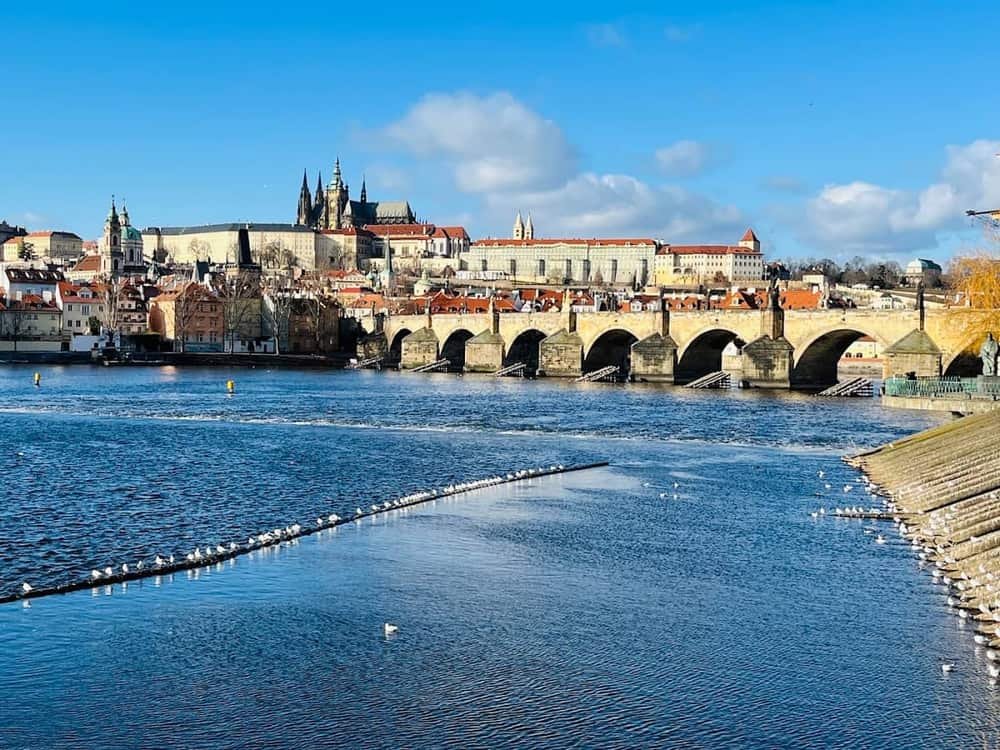
And the architecture will surprise even those who know Sibiu or Brașov: the centre came through the twentieth century almost undamaged, so Gothic, Baroque and Art Nouveau stand street after street.
The mistakes people from Romania actually make
Driving into the centre. The historic core is a maze of one-way streets, residents' parking zones and pedestrian areas. Leave the car at a P+R car park on the edge of the city or at your hotel, and use the metro.
Changing money on the street or at the first exchange office. Covered above, and still the most expensive mistake in the city.
Doing the Castle at noon. The security check and the cathedral queue both build through the morning. Go at opening time, or late in the afternoon.
Eating on the Old Town Square. The view is included in the bill. Walk two streets back, or one tram stop out.
Forgetting a vignette. Czech motorway cameras read number plates, and the fine arrives even if nobody stopped you.
How long to stay
Flying in, three nights is the right first visit: one day for the Castle side, one for the Old Town and Josefov, one for the neighbourhoods and a long evening in a beer hall.
Driving from Romania, add a night at each end, or break the journey in Budapest or Bratislava — nobody should arrive in Prague after twelve hours at the wheel and try to enjoy an evening.
Five days or more buys a day trip: Karlštejn or Kutná Hora by train, or Český Krumlov if you have the car.
Where to stay
Live prices and availability on a map centred on this exact spot — hotels, apartments and hostels, so you can judge the walk from here rather than guess from an address.
Bookings made through this map earn us a commission. Your price is unaffected.
Questions from Romanian visitors
What is the best way to get to Prague from Romania?
From Bucharest and most of the country, by air: a direct flight takes around two hours. Driving makes sense from the west of Romania or for a group — the route crosses Hungary and Slovakia and is a long day at the wheel.
How many vignettes do I need to drive to Prague?
On the route through Hungary and Slovakia, three: Hungarian, Slovak and Czech. Via Vienna you also need the Austrian one. All are electronic, tied to your number plate, and should be bought from the official sites rather than from resellers.
Can I pay in lei or euros in Prague?
Effectively no, and where euros are accepted the rate is poor. Czechia uses the koruna. Pay by card, decline dynamic currency conversion when a machine offers to charge you in lei, and avoid the exchange offices on the tourist streets.
Which beer hall is worth it on a first visit?
Lokál, for tank Pilsner and honest Czech food with locals at the next table. U Fleků is worth it for the history but is touristy — refuse the shot put on the table unasked. In summer, the Letná beer garden has the best view in the city.
Can I drive into central Prague?
You can, but it is not worth it. The historic centre has one-way streets, pedestrian zones and residents-only parking. Leave the car at a P+R car park on the edge of the city next to the metro, or at your hotel.