
The city
Prague's café tradition: where writers, rebels and regulars drank coffee
Tony Denesa – Travel Advisor9 min read
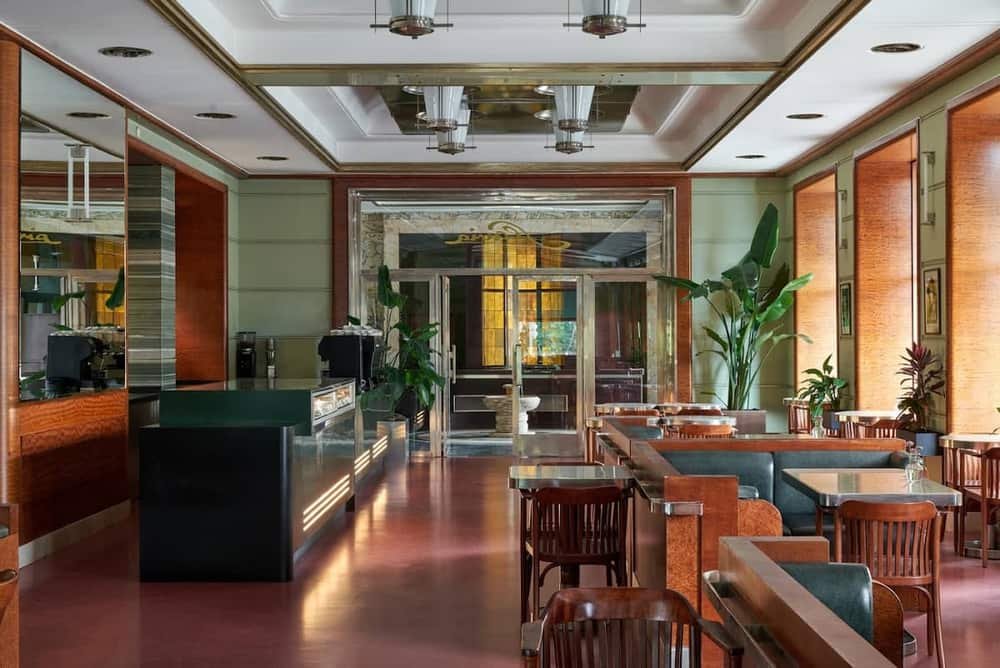
Prague is famous for beer, but it has another drinking tradition just as deeply rooted: the café. For more than a century, the city's grand coffee houses were its living rooms, reading rooms and debating halls, where writers wrote, artists argued, students plotted and regulars sat for hours over a single cup. Many of these rooms have survived, and sitting in one is one of the great pleasures of a visit. Browse them in the cafés section.
The Viennese inheritance
The Prague café grew out of the coffee-house culture of the Habsburg Empire, with Vienna as its model. By the late nineteenth century, the city had dozens of cafés with marble tables, bentwood chairs, newspapers on wooden holders, billiard tables and waiters in black jackets. A café was a place where, for the price of a coffee, you could stay all afternoon, read the papers from across Europe, write letters and meet friends.
The menus still show that heritage: Viennese coffee (*vídeňská káva*) topped with whipped cream, apple strudel, and cakes such as *větrník* and *věneček*.
A city of many languages
Before the First World War, Prague was a city of Czechs, Germans and Jews, and its cafés reflected that. Some were Czech-speaking, others German-speaking, and a few became meeting points between communities. The Café Arco near Hybernská street was the haunt of the German-speaking Jewish writers of the "Prague Circle" — Max Brod, Franz Werfel and their friend Franz Kafka — so much so that they were nicknamed the *Arconauts*. The Arco has long gone, but its legend remains.
The great cafés you can still visit
Café Slavia — opened in 1884 opposite the National Theatre, with big windows looking across the Vltava to Prague Castle. For more than a century it was the café of actors, writers, painters and dissidents; the poet Jaroslav Seifert and the playwright Václav Havel were among its regulars. On the wall hangs Viktor Oliva's painting *The Absinthe Drinker*. After the Velvet Revolution, a dispute over the building closed it in the 1990s, and its reopening in 1997 was celebrated as the return of a national institution.
Café Louvre — opened in 1902 on Národní třída, on the first floor. Kafka and Max Brod came here, and it is said that Albert Einstein did too during his time teaching in Prague. Nationalised and closed under communism, it reopened in 1992 with its high ceilings, pastel walls and billiard room restored.
Grand Café Orient — the only Cubist café in the world, on the first floor of Josef Gočár's House of the Black Madonna from 1912. Its lamps, furniture, coat hooks and even the bar were designed in the angular Cubist style. The café closed after only a decade, and was faithfully recreated and reopened in 2005. Read more in Prague architecture.
Kavárna Obecní dům — the Art Nouveau café in the Municipal House, completed in 1912, with chandeliers, brass fittings and a fountain. It is one of the most beautiful rooms in Prague.
Café Imperial — opened in 1914, its walls and ceiling covered in glazed ceramic tiles and reliefs in a style between Art Nouveau and Art Deco.
Café Savoy — on the Malá Strana side, near the bridge to the National Theatre, with a painted Neo-Renaissance ceiling and a bakery famous for its breakfasts and cakes.
Kavárna Lucerna — in the Lucerna Palace, built by Václav Havel's grandfather in the early twentieth century, above the passage where David Černý's statue of St. Wenceslas rides an upside-down horse.
Under communism
After 1948, private cafés were nationalised. Many were closed, turned into canteens or offices, or run down by state enterprises. The Louvre closed; the Orient's Cubist interior disappeared. Some cafés survived, but as grey, standardised places with little of their old atmosphere. The Slavia, however, remained a gathering place for artists and, quietly, for people who thought differently, watched by informers from the next table. See communism in Prague.
The revival
After 1989, the great cafés were restored one by one, often by new owners who researched old photographs to recreate lost interiors. At the same time, a new café culture emerged: specialty coffee roasters and small espresso bars in Vinohrady, Karlín and Holešovice, with baristas, single-origin beans and brunch menus. Prague now has both — the grand historic room and the minimalist neighbourhood café — often a few streets apart.
How to enjoy a Prague café
- Take your time. Sitting for an hour or two over a coffee and a cake is exactly the point.
- Go in the morning or mid-afternoon to avoid queues at the most famous cafés.
- Try the classics: Viennese coffee, apple strudel, a *větrník* or a slice of cake from the counter.
- Ask for a window table at the Slavia for the view of the Castle across the river.
- Tip by rounding up the bill, around ten per cent for good service.
A café walk
- Breakfast at Café Savoy in Malá Strana.
- Cross the bridge to the Slavia for coffee with a view.
- Walk along Národní třída to the Louvre.
- Continue to the Grand Café Orient on Celetná street.
- Finish at the Municipal House café.
Build it into a slow day with the itinerary builder. And when coffee turns to beer, the beer halls are waiting.
Where to stay nearby
Live prices and availability on a map centred on this exact spot — hotels, apartments and hostels, so you can judge the walk from here rather than guess from an address.
Bookings made through this map earn us a commission. Your price is unaffected.