
The city
Statues and memory: how Prague argues with its monuments
Tony Denesa – Travel Advisor10 min read
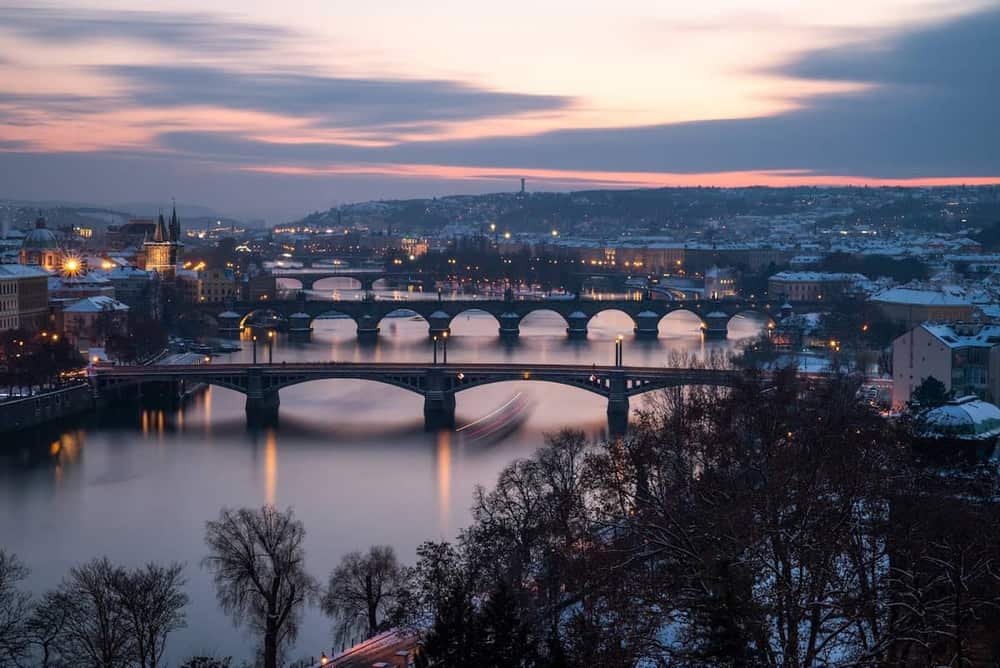
Every regime that has ruled Prague has tried to write its story in bronze and stone — and almost every one has seen its monuments pulled down by the next. Walk through the city with that in mind and its statues become a history lesson in themselves: saints and emperors, national heroes, a vanished Stalin, and the ironic sculptures of David Černý. For the wider history, see communism in Prague and 1968 and 1989.
Saints on the bridge, a column in the square
The oldest public statues in Prague are religious. The Baroque saints on Charles Bridge, added from the late seventeenth century, were part of the Catholic Counter-Reformation's effort to win back a city that had once been a stronghold of Protestant reform. Most on the bridge today are copies; the originals are kept in the Lapidarium of the National Museum and in the casemates of Vyšehrad.
On Old Town Square, a Marian Column was erected around 1650 to give thanks for the city's defence against the Swedes in 1648. For many Czechs it came to symbolise Habsburg and Catholic domination. On 3 November 1918, days after independence, a crowd pulled it down. For a century the square stood without it — until a replica was built and consecrated in 2020, after years of passionate debate between those who saw it as a restored work of art and those who saw a symbol of oppression.
Jan Hus and the national heroes
Facing the column's site stands the great Jan Hus Monument by Ladislav Šaloun, unveiled in 1915, five hundred years after the reformer was burned at the stake in Konstanz. Hus, the preacher who challenged the Church and became a national symbol, looks out over the square, surrounded by figures of the Hussite warriors and of the exiles who left after the Protestant defeat.
At the top of Wenceslas Square, Josef Václav Myslbek's equestrian statue of St. Wenceslas, the patron saint of Bohemia, surrounded by other Czech patron saints, was completed in the early twentieth century. It became the city's gathering point: in 1918 for independence, in 1968 against the invasion, and in 1989 for the Velvet Revolution.
At Vyšehrad, Myslbek's large statues of legendary Czech heroes — Libuše and Přemysl, Záboj and Slavoj, Lumír and Song, Ctirad and Šárka — stand in the park, and the Slavín tomb in the cemetery holds dozens of the nation's great artists.
An empire's generals come down
After 1918, the new republic removed symbols of Habsburg power. The statue of the Austrian field marshal Radetzky, which stood on Malostranské náměstí, was taken down in 1919. It survives in the Lapidarium, a museum of Czech sculpture — a pattern the city would repeat.
The biggest Stalin in the world
In the 1950s, the communist regime built its most ambitious monument on the Letná plateau above the river: a colossal granite group of Stalin leading a line of workers and soldiers, the largest statue of Stalin ever made. Its sculptor, Otakar Švec, took his own life before it was unveiled on 1 May 1955. Praguers nicknamed it *the meat queue* because of the figures lined up behind Stalin.
Only a few years later, after Khrushchev condemned Stalin's crimes, the monument became an embarrassment. In 1962 it was destroyed with explosives. Its huge plinth remained empty for decades; since 1991 it has carried a giant red Metronome, ticking above the city — one of the best viewpoints in Prague and a favourite place for skaters.
Soviet tanks and marshals
In Smíchov, a Soviet tank stood on a pedestal as a memorial to the Red Army's arrival in Prague in May 1945. In 1991, the artist David Černý painted it pink. The authorities repainted it green; members of parliament painted it pink again. The tank was eventually removed from the square and now stands in a military museum outside Prague.
In the Prague 6 district, a statue of Soviet Marshal Ivan Konev, whose troops reached Prague in 1945, was repeatedly vandalised and became a symbol of Russia's contested role in Czech history. In April 2020 the district removed it, prompting an angry diplomatic response from Moscow. It is to be placed in a museum of twentieth-century memory.
Remembering the victims
- At the foot of Petřín, on Újezd street, the Memorial to the Victims of Communism (2002) by Olbram Zoubek shows bronze figures descending a staircase, each more broken than the last.
- In front of the National Museum, a cross set into the pavement marks where Jan Palach and Jan Zajíc protested in 1969.
- On Národní třída, a plaque with raised hands marks the police attack on students on 17 November 1989.
- In the crypt of the Church of Sts. Cyril and Methodius, the National Memorial to the Heroes of the Heydrich Terror tells the story of the parachutists who assassinated Reinhard Heydrich in 1942.
- Across the city, small brass Stolpersteine in the pavement carry the names of Jews and others deported from their homes by the Nazis. See Jewish Prague.
David Černý: the city's provocateur
No artist has shaped the modern argument over Prague's public space like David Černý. After the pink tank came:
- the giant faceless babies crawling up the Žižkov Television Tower and on Kampa;
- Hanging Out, a figure of Sigmund Freud dangling by one hand from a pole above an Old Town street;
- a St. Wenceslas riding an upside-down dead horse in the Lucerna passage, a parody of Myslbek's statue;
- two men urinating into a pool shaped like the Czech Republic outside the Kafka Museum;
- and the shimmering, rotating head of Franz Kafka (2014), made of stainless steel layers behind the Quadrio shopping centre.
His works are funny, irreverent and political — a way for a free city to laugh at the solemn monuments of the past.
Kafka and Masaryk return
Other statues mark the city's post-1989 identity. Near the Spanish Synagogue, Jaroslav Róna's bronze of Kafka riding on the shoulders of an empty suit (2003) honours the writer the communists ignored. On Hradčany Square, a statue of the first president Tomáš Garrigue Masaryk, removed from public life under communism, was unveiled in 2000. See Czechoslovakia and the First Republic.
A statue walk
- Start at Old Town Square — the Hus Monument and the rebuilt Marian Column.
- Walk to Wenceslas Square for St. Wenceslas, the Palach memorial and the Lucerna horse.
- Cross the river for the Memorial to the Victims of Communism at Újezd.
- Climb to Letná and stand under the Metronome where Stalin used to be.
Build it into a day with the itinerary builder.
Where to stay nearby
Live prices and availability on a map centred on this exact spot — hotels, apartments and hostels, so you can judge the walk from here rather than guess from an address.
Bookings made through this map earn us a commission. Your price is unaffected.