The city
Prague architecture: a thousand years of styles in one walk
Tony Denesa – Travel Advisor11 min read
Few cities let you walk through a thousand years of architecture as easily as Prague. It escaped the heavy bombing that destroyed so many European centres in the Second World War, and its historic core is protected as a UNESCO World Heritage Site. In a single afternoon you can pass a Romanesque rotunda, a Gothic cathedral, a Baroque church, an Art Nouveau café, a Cubist house and a deconstructivist office block. Here is how to recognise each style, and where to see the best examples.
Romanesque (10th–13th centuries)
The oldest surviving buildings are small and solid: thick walls, round arches and tiny windows. Prague has three rare Romanesque rotundas — round chapels with a small apse — including the Rotunda of St. Martin at Vyšehrad and the Rotunda of the Holy Cross in the Old Town. At Prague Castle, the twin white towers of St. George's Basilica hide a Romanesque interior behind a later Baroque façade.
Many Old Town houses also have Romanesque cellars: the streets were raised in the Middle Ages to protect against floods, so former ground floors became basements. Some restaurants and bars now occupy them.
Gothic (13th–16th centuries)
Gothic Prague is the city of Charles IV — see Charles IV and medieval Prague. Look for pointed arches, ribbed vaults, flying buttresses and soaring spires.
- St. Vitus Cathedral — begun in 1344, with Peter Parler's net vaults and the jewel-like Chapel of St. Wenceslas.
- The Týn Church — the twin spiky towers that dominate Old Town Square.
- Charles Bridge and the Old Town Bridge Tower, one of the finest Gothic towers in Europe.
- The Old-New Synagogue in Josefov, a rare medieval synagogue still in use.
- The Powder Tower — a late Gothic gate from 1475, once part of the Old Town fortifications.
- Vladislav Hall in the Old Royal Palace, with late Gothic vaults as intricate as lace.
Renaissance (16th–early 17th centuries)
The Renaissance arrived from Italy with the Habsburgs. Its buildings are calmer and more ordered, with arcades, gables and decorated façades.
- The Royal Summer Palace (Belvedere) in the Royal Garden, with its elegant arcades and copper roof shaped like an upturned ship's hull.
- Schwarzenberg Palace on Hradčany Square, covered in black-and-white sgraffito — patterns scratched through layers of plaster to imitate stone blocks.
- Many Old Town and Malá Strana houses have Renaissance gables and painted façades hidden among later styles.
Baroque (17th–18th centuries)
After the Catholic victory at the Battle of White Mountain in 1620, the Counter-Reformation filled Prague with Baroque churches and palaces designed to dazzle. This is the style that gives Malá Strana its domes and its drama.
- St. Nicholas Church in Malá Strana — the masterpiece of the Dientzenhofer family, with a huge green dome and a theatrical interior.
- The Loreto — a pilgrimage site with a carillon tower and a treasury of glittering monstrances.
- Wallenstein Palace and the Waldstein Garden — early Baroque power, built for the general Albrecht von Wallenstein.
- The statues on Charles Bridge, added from the late seventeenth century.
- Strahov Library — Baroque and Neoclassical halls of books under painted ceilings.
Historicism and the national revival (19th century)
In the nineteenth century, Czech patriots built monuments to their nation in revived historic styles, especially Neo-Renaissance.
- The National Theatre — with its golden roof on the riverbank, built with money collected across the nation.
- The National Museum — crowning Wenceslas Square.
- The Rudolfinum — the concert hall on the river, home of the Czech Philharmonic.
- The Church of Sts. Peter and Paul at Vyšehrad — Neo-Gothic spires above the national cemetery.
Art Nouveau (around 1895–1915)
The *secese*, as Czechs call it, brought flowing lines, floral ornament, stained glass, mosaics and sculpted faces to the façades of a booming city.
- The Municipal House — completed in 1912, the finest Art Nouveau building in Prague, with work by Alfons Mucha and many other Czech artists.
- The historic hall of Prague main station, the Fanta Building, with its domed hall and sculptures.
- Hotel Paris and the façades of Pařížská street, and the apartment blocks of Vinohrady.
Read more in our blog post on Art Nouveau and Cubism in Prague.
Cubism (around 1911–1925)
Prague is the only city where Cubism, the movement of Picasso and Braque, was applied fully to architecture. Czech architects folded façades into crystals and prisms.
- The House of the Black Madonna on Celetná street by Josef Gočár, 1912 — now home to the Grand Café Orient.
- The Cubist lamp post on Jungmannovo náměstí, the only one in the world.
- Cubist villas and apartment houses below Vyšehrad, on Neklanova street and along the riverbank.
After the First World War, a national variant called Rondocubism added round, rolling forms and bright colours, as on the Legiobank building in the New Town.
Functionalism and the First Republic (1920s–1930s)
The democratic Czechoslovakia of the interwar years embraced modern architecture: clean lines, flat roofs, glass and steel. See Czechoslovakia and the First Republic.
- The Trade Fair Palace — a giant functionalist exhibition hall, now the National Gallery's modern collection.
- The Müller Villa — Adolf Loos's 1930 villa in Střešovice, a landmark of modern domestic architecture, visited by guided tour.
- The Baba estate — a model settlement of functionalist villas in Dejvice.
Communist era (1948–1989)
- The Hotel International in Dejvice — a Stalinist wedding-cake tower in the socialist realist style of the 1950s.
- The Žižkov Television Tower — a futuristic concrete and steel tower completed around 1992, now climbed by David Černý's giant babies.
- Brutalist buildings such as the former Hotel Intercontinental on the river and the Kotva department store.
Contemporary Prague
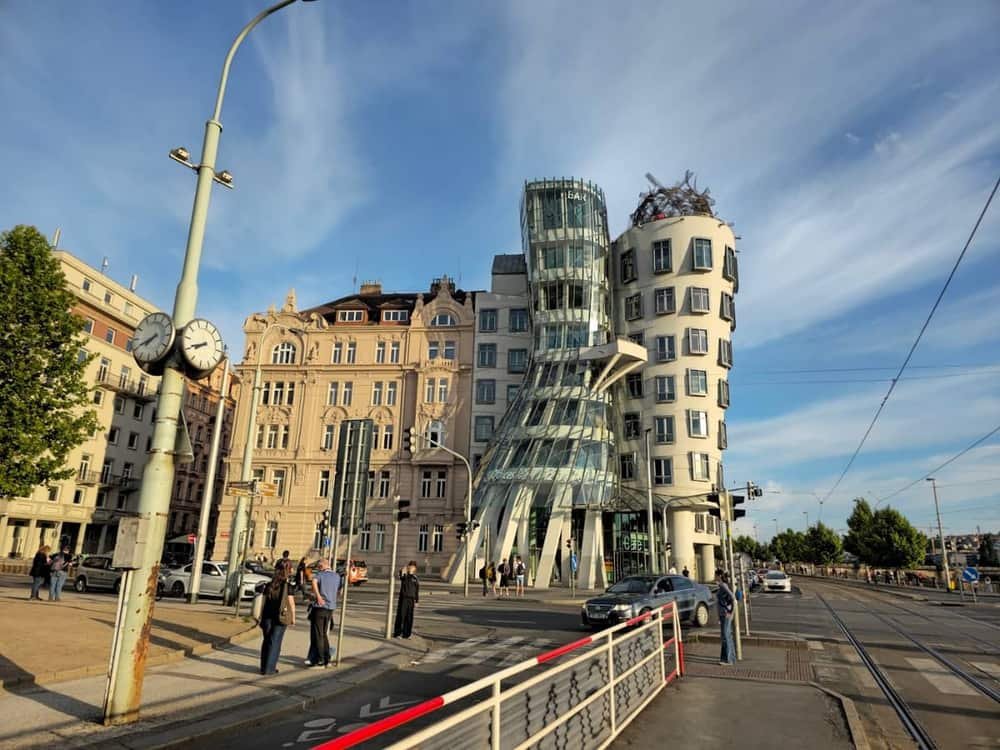
The Dancing House (1996), by Frank Gehry and Vlado Milunić, is Prague's most famous modern building: two towers that lean together like a couple dancing, nicknamed *Ginger and Fred*. It stands on a riverfront site left empty after wartime bombing. Newer districts such as Karlín mix restored industrial halls with glass offices.
An architecture walk
- Start at the Dancing House, then walk the riverbank south to the Cubist houses below Vyšehrad and climb to the Rotunda of St. Martin.
- Take the tram to the Municipal House and the Powder Tower, then walk Celetná street past the House of the Black Madonna to Old Town Square and the Týn Church.
- Cross Charles Bridge into Malá Strana for St. Nicholas, and climb to the Castle for St. Vitus and Vladislav Hall.
Plan the route with the itinerary builder.
Where to stay nearby
Live prices and availability on a map centred on this exact spot — hotels, apartments and hostels, so you can judge the walk from here rather than guess from an address.
Bookings made through this map earn us a commission. Your price is unaffected.