
Blog
Prague's Art Nouveau and Cubism: the city that took a painting style and built houses out of it
Tony Denesa – Travel Advisor8 min read
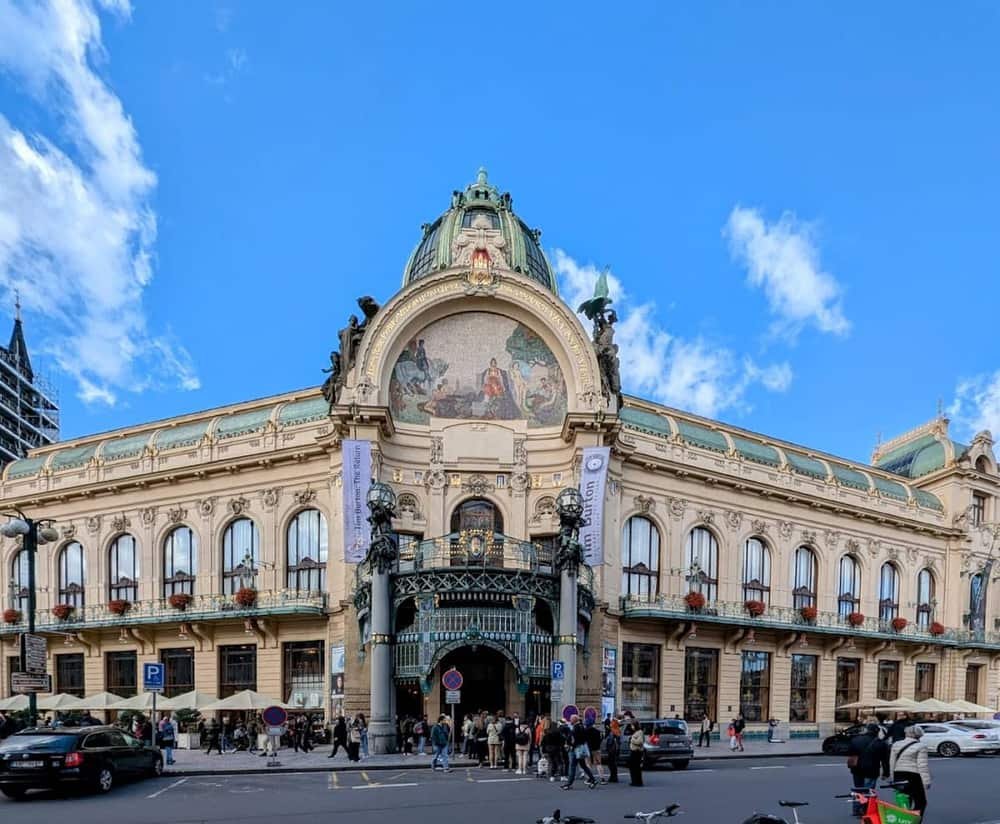
Prague photographs as a Gothic and Baroque city, and mostly it is one. But the two decades before the First World War gave it something rarer: first a burst of Art Nouveau as good as Vienna's, and then — for about three years, in one city, and nowhere else on the planet — Cubist architecture. Painters elsewhere put Cubism on canvas. Prague built it.
This piece covers both, in the order you would walk them.
The Municipal House, where the style peaks
The Municipal House — Obecní dům — went up between 1905 and 1912 on the site of the medieval royal court, next to the Gothic Powder Tower, and it is the complete statement of Czech Art Nouveau: a building where the architecture, the mosaics, the railings, the light fittings and the coat hooks were all designed as one object.
Inside is Smetana Hall, the city's grandest concert room, and a sequence of salons decorated by the leading Czech artists of the day — the finest of them the Lord Mayor's Hall, painted entirely by Alfons Mucha. On 28 October 1918, Czechoslovak independence was proclaimed from this building, which is a large part of why it means more to the city than its decoration alone.
You have three ways in: a concert, a guided tour, or — cheapest and very pleasant — the ground-floor Kavárna Obecní dům, a working grand café under the original chandeliers. The grand cafés are, in general, the easiest doors into Prague's Art Nouveau interiors.
Mucha, the local hero who came home
Mucha made his name in Paris in the 1890s with theatre posters for Sarah Bernhardt, and spent his last decades in Prague working on what he considered his real work. The Mucha museum near Wenceslas Square holds the posters and drawings and is a compact hour.
His most surprising work in the city is a window: the stained glass he designed in 1931 for St Vitus Cathedral, in the third chapel on the left as you enter — painted rather than leaded in the traditional way, unmistakably his, and included in the basic cathedral circuit.
Two more Art Nouveau stops
The Jerusalem Synagogue, 1906, on Jeruzalémská street near the main station, is the one that makes visitors stop mid-sentence: a Moorish Revival facade in red and cream stripes with Art Nouveau decoration threaded through it, and an interior to match. It is still a functioning synagogue, open to visitors most of the year — and far less crowded than the Spanish Synagogue in Josefov.
The Fanta Building at the main railway station is Josef Fanta's 1900s station hall, with a domed café space upstairs above the modern concourse. Most people rush under it to the metro without ever looking up.
Then Cubism happens
Around 1911, a group of young Czech architects decided that Art Nouveau's vines and maidens were already stale, and that the crystalline geometry Picasso and Braque were putting on canvas could be built. The theorist Pavel Janák argued that the flat wall was dead matter, and that surfaces should break into prisms and pyramids.
Nowhere else did anyone try it on actual buildings. In Prague they built houses, a café, furniture — and one lamppost.
The House of the Black Madonna on Celetná street, by Josef Gočár, 1912, is the masterpiece: a department store whose bays and mouldings fold like cut crystal, named for the Baroque statue rescued from the previous building and kept on its corner. On the first floor is the Grand Café Orient — the world's only Cubist café, closed in the 1920s and reconstructed in 2005 down to the Cubist chandeliers and the striped upholstery. Coffee there costs café prices and buys you a seat inside the movement.
The Cubist lamppost, by Emil Králíček, around 1913, stands in a quiet corner of Jungmannovo náměstí, two minutes from Wenceslas Square — a faceted concrete column that is, as far as anyone knows, the only Cubist street lamp ever made. Finding it is half the pleasure.
The Vyšehrad villas. Below the Vyšehrad fortress, Josef Chochol built the densest cluster: the Kovařovic Villa on Libušina street with its faceted garden facade, the triple house on the Rašínovo nábřeží embankment, and the Hodek apartment house on Neklanova street, whose sharpened corner balconies still look avant-garde. All are private — you come for the exteriors, and they string naturally onto a Vyšehrad morning.
What came after
Independence in 1918 pushed the style one step further into Rondocubism — the prisms softened into circles and arcs in national red and white. The Legiobanka on Na Poříčí (Gočár again, 1923) and the Adria Palace near the National Theatre are the two big statements, before functionalism arrived and ornament of any kind fell out of favour.
A walk that connects it all
Start at the Municipal House with a coffee. Through the Powder Tower, down Celetná to the House of the Black Madonna — the Grand Café Orient if you skipped the first coffee. Past the Estates Theatre to Jungmannovo náměstí for the lamppost, then the Mucha museum. That is a relaxed half-day.
The Vyšehrad villas are a separate outing — metro to Vyšehrad, walk the ramparts, come down the Libušina side. Cubism first, fortress after, and the Náplavka embankment below to finish.
Where to stay nearby
Live prices and availability on a map centred on this exact spot — hotels, apartments and hostels, so you can judge the walk from here rather than guess from an address.
Bookings made through this map earn us a commission. Your price is unaffected.