The city
Music in Prague: Mozart's favourite audience, Smetana's river and Dvořák's hall
Tony Denesa – Travel Advisor9 min read
There is an old saying that every Czech is a musician — *co Čech, to muzikant*. Walk through Prague on any evening and it seems true: string quartets in Baroque churches, opera in gilded theatres, jazz in cellars and posters for concerts on every corner. Music is woven into the history of the city and into the story of the Czech nation itself.
Mozart and Prague
Wolfgang Amadeus Mozart loved Prague, and Prague loved him back, often more warmly than Vienna did. After *The Marriage of Figaro* became a sensation in the city, he was commissioned to write a new opera for Prague. Don Giovanni premiered at the Estates Theatre on 29 October 1787, with Mozart conducting. The theatre still stands in the Old Town, one of the few surviving opera houses where Mozart himself performed, and *Don Giovanni* is still performed there.
Smetana and the sound of a nation
In the nineteenth century, music became part of the Czech national revival, the movement to restore the Czech language and culture within the Habsburg Empire. Bedřich Smetana was its musical voice. His opera *The Bartered Bride* brought Czech village life to the stage, and his cycle of symphonic poems Má vlast ("My Homeland") includes Vltava, which follows the river from its springs through the countryside to Prague. It is the most famous piece of Czech music, and when you stand on Charles Bridge above the water, it is hard not to hear it.
The National Theatre on the riverbank was built with money collected from across the nation, under the motto *Národ sobě* — "the nation to itself". It opened in 1881, burned down within weeks, was rebuilt with a second national collection and reopened in 1883 with Smetana's opera *Libuše*.
Dvořák and the Rudolfinum
Antonín Dvořák took Czech music to the world. His Slavonic Dances made him famous; his years in America produced the Symphony *From the New World*; his opera *Rusalka* includes the *Song to the Moon*, one of the best-loved soprano arias ever written.
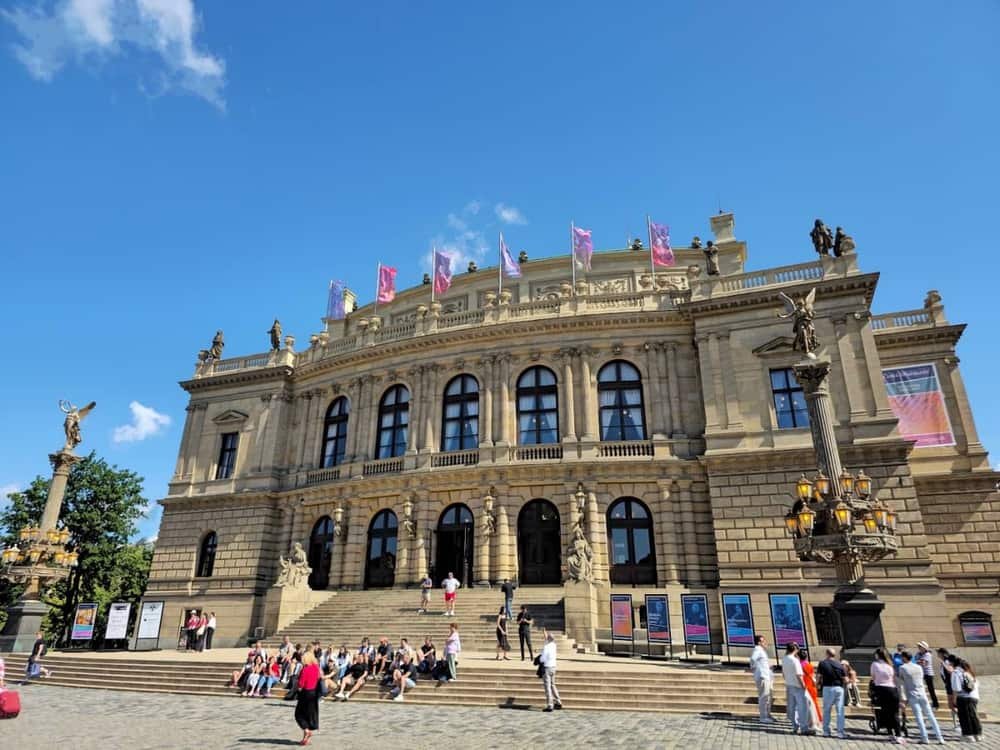
In 1896, Dvořák conducted the first concert of the Czech Philharmonic in the Rudolfinum, the neo-Renaissance concert hall on the river in Josefov. The orchestra still calls it home, and its Dvořák Hall is one of the finest concert halls in Europe.
Janáček, Martinů and the twentieth century
The Moravian composer Leoš Janáček wrote operas of raw emotion, such as *Jenůfa* and *The Cunning Little Vixen*, and his Sinfonietta opens with a blaze of brass. Bohuslav Martinů spent much of his life abroad, in Paris and America, but kept a Czech voice in his music. Between the wars, Prague had a lively jazz and cabaret scene and a strong avant-garde.
Music under communism
After 1948, classical music was supported but closely watched, and Western popular music was treated with suspicion. Jazz survived in clubs such as the Reduta on Národní třída, where, years later, in 1994, President Bill Clinton played the saxophone during a visit hosted by Václav Havel.
Rock became a form of resistance. When members of the underground band The Plastic People of the Universe were put on trial in 1976, dissidents rallied to defend them. The protest grew into Charter 77, the human-rights declaration co-authored by Havel — a direct line from a rock band to the Velvet Revolution of 1989. Read more in communism in Prague.
The Prague Spring festival
Every year since 1946, the Prague Spring International Music Festival has opened on 12 May, the anniversary of Smetana's death, traditionally with a performance of *Má vlast*. For about three weeks it fills the Rudolfinum, the Municipal House and other venues with orchestras, soloists and chamber music. See Prague in spring and the events calendar.
Where to hear music today
- The Czech Philharmonic at the Rudolfinum — the benchmark for symphonic music in Prague.
- Smetana Hall in the Municipal House — an Art Nouveau jewel and home of the Prague Symphony Orchestra.
- The National Theatre, the State Opera and the Estates Theatre — opera and ballet from the National Theatre company, often with good-value tickets.
- Jazz clubs in the Old Town and New Town, several in atmospheric cellars.
- Church concerts — many Baroque churches host evening concerts aimed at visitors.
How to choose a concert
Flyers for concerts are handed out all over the Old Town, and quality varies widely. Some are excellent chamber performances in beautiful spaces; others are short programmes of greatest hits played for tour groups. To pick well:
- Check who is playing. A named orchestra, ensemble or soloist with a website is a good sign.
- Buy from the venue or the orchestra, not from someone on the street.
- Look at the programme. A full work — a symphony, a quartet, a complete opera — usually means a serious performance.
- Compare the seasons. The main orchestras and the National Theatre publish their seasons months in advance, and the best seats sell early.
After the concert, the evening continues naturally in a beer hall or a late café nearby. Plan the whole evening with the itinerary builder.
Where to stay nearby
Live prices and availability on a map centred on this exact spot — hotels, apartments and hostels, so you can judge the walk from here rather than guess from an address.
Bookings made through this map earn us a commission. Your price is unaffected.