
The city
Prague's trams and metro: how the city learned to move
Tony Denesa – Travel Advisor9 min read
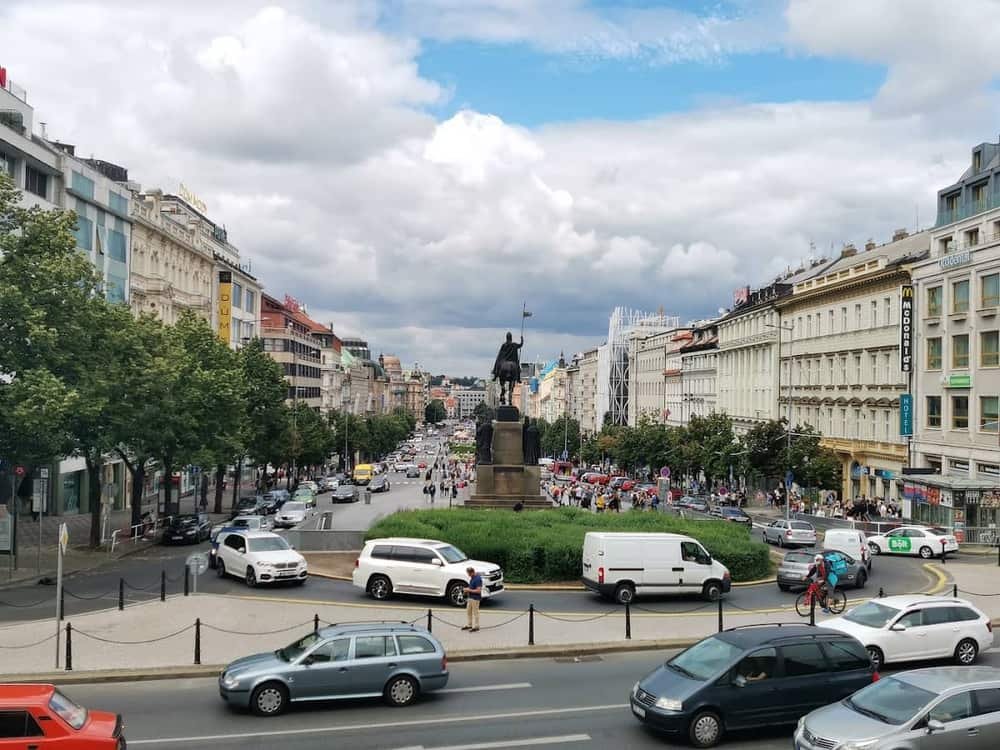
Most visitors meet Prague's public transport within an hour of arriving — the trolleybus from the airport, the long escalators down into the metro, the red trams rattling over the river. It is one of the best systems in Europe, and one of the most characterful. Its history is a history of the city itself. For the practical side — tickets, apps and routes — see getting around Prague.
Horses and the first rails
Prague's first horse-drawn tram ran in 1875, from Karlín, then a growing industrial suburb, towards the centre. Horse trams spread along the main streets over the following decades, carrying passengers at walking pace between the old towns and the new districts rising beyond the walls.
Křižík and the electric age
The electric tram arrived thanks to František Křižík, a Czech engineer and inventor often called the Czech Edison. In 1891, for the Jubilee Exhibition at Výstaviště in Holešovice, he built an electric tram line near Letná, one of the first in the Austro-Hungarian monarchy. The same exhibition gave Prague the first Petřín funicular and the Petřín lookout tower.
Within a few years the city began electrifying its own network, and by the early twentieth century electric trams had replaced horses. The municipal transport company — the ancestor of today's Prague Public Transit Company (DPP) — took over the lines, and the tram became the backbone of how the city moved.
Between the wars
In the First Czechoslovak Republic, Prague grew fast. New neighbourhoods such as Vinohrady, Žižkov, Dejvice and Holešovice were tied to the centre by tram lines. Buses appeared on the edges of the network, and trolleybuses joined later. The tram map of the 1930s already looks recognisably like today's.
The Tatra T3
After the Second World War, the ČKD Tatra works in Smíchov began building a tram based on an American design. The result, the Tatra T3, entered service in the early 1960s and became one of the most-produced tram types in history, with thousands built for cities across the Eastern Bloc and beyond. Modernised T3s still run in Prague, alongside the low-floor Škoda trams of the twenty-first century. You can see historic models at the Public Transport Museum in the Střešovice depot.
A metro for the Cold War
By the 1960s the trams in the centre were overloaded. Plans for an underground tram gave way to a full metro, built with Soviet cooperation. The first section of line C opened on 9 May 1974. Line A followed in 1978, and line B in 1985. The three lines — green A, yellow B and red C — cross in the centre at Muzeum, Můstek and Florenc.
Some stations were built very deep, both to pass under the old city and the river and to serve as civil defence shelters, with heavy blast doors that are still in place. That is why the escalators at stations like Náměstí Míru, on the edge of Vinohrady, are among the longest in the European Union. The stations of the 1970s and 1980s are a gallery of late-socialist design, with anodised metal panels, glass and stone.
Many station names changed after 1989, when references to the communist era were removed.
The flood of 2002
In August 2002, the Vltava rose to one of the highest levels ever recorded, and water poured into the metro. Around twenty stations were flooded, some to the ceiling, and parts of the network were closed for months. The stations were rebuilt, and flood barriers along the river and in the tunnels were strengthened. The story of the river and its floods is told in the Vltava in Prague.
Today and tomorrow
Today the network is run under the integrated PID system, with one ticket valid on metro, trams, buses, some ferries and the funicular. Trams run all night on dedicated night lines, the metro has been extended far into the suburbs, and a new line D, planned as the first fully automated line, is under construction towards the south of the city.
For visitors, the history is also a sightseeing tip: tram 22 climbs from the New Town across the river to the Castle and is the best cheap tour of Prague. Ride it from the New Town up to Hradčany, and read how to buy the ticket on our prices page. Then walk down to Malá Strana and plan the rest of your days with the itinerary builder.
Details to look for as you ride
- The station chimes. Before the metro doors close, a recorded voice says *"Ukončete, prosím, výstup a nástup, dveře se zavírají"* — "please finish getting off and on, the doors are closing". Every Praguer can recite it.
- The metro walls. Line A's stations are lined with bulging, coloured anodised-aluminium panels, one colour per station; line B's stations use glass and stone; line C's older stations have the most classic 1970s look.
- The tram bells. Trams ring a bell rather than a horn; when you hear it on a narrow street in the Old Town or Malá Strana, step aside.
- The nostalgic trams. In the warmer months, historic tram cars run on a special sightseeing line at weekends, a nice way to see the old vehicles in motion.
- The funicular. Rebuilt more than once since 1891, the Petřín funicular reopened with new cabins in September 2026.
Where to stay nearby
Live prices and availability on a map centred on this exact spot — hotels, apartments and hostels, so you can judge the walk from here rather than guess from an address.
Bookings made through this map earn us a commission. Your price is unaffected.