
Blog
Prague beyond the centre: five places that earn the tram ride
Tony Denesa – Travel Advisor9 min read
Most visitors to Prague spend three days inside a circle a kilometre and a half across, and for a first visit that is the right call — the centre really is that dense. But the city keeps going, and a handful of places beyond the tourist perimeter offer things the centre simply does not have.
This is not a list of hidden gems. Much of outer Prague is honest residential city with nothing particular for a visitor, and pretending otherwise would waste your afternoon. These five are worth it, with the caveats stated.
Vršovice — Krymská street and a vineyard
Vršovice, one tram ride south-east of Vinohrady, is where Prague's café-and-bar generation actually lives. The centre of gravity is Krymská — a short, scruffy, uphill street that the foreign press periodically declares one of the coolest in Europe, which the locals find funny, because it is mostly a hill with bars on it. That is also exactly its charm: mismatched cafés, a cinema bar, vinyl, cheap wine, nobody performing for tourists.
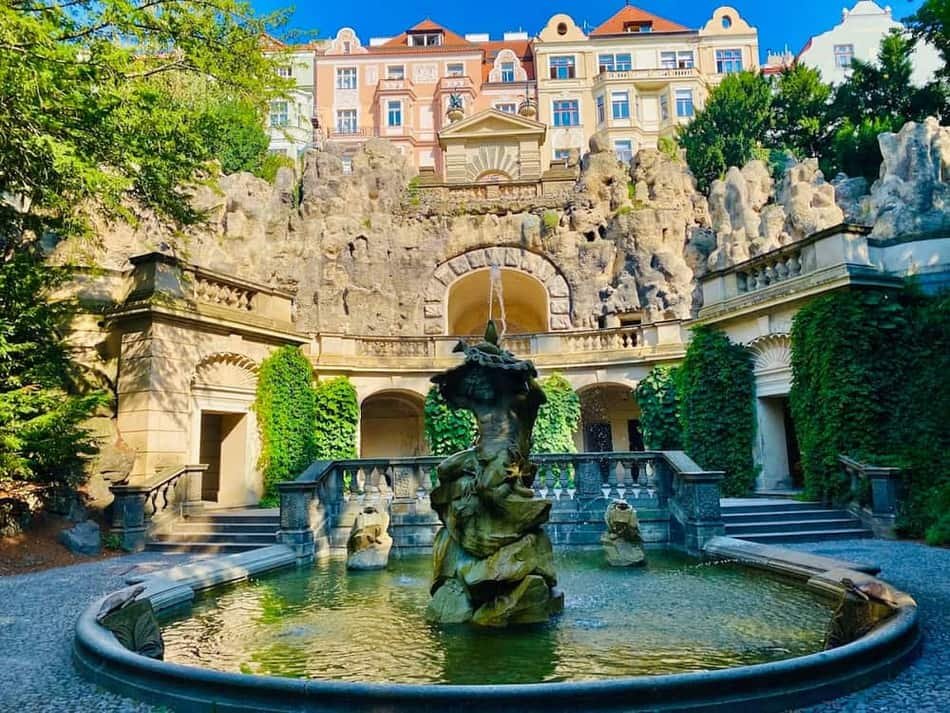
Two streets away is the district's real prize: Havlíčkovy sady, known to everyone as Grébovka — a landscaped park draped over a hillside with a working vineyard in the middle of it. Vines have grown on this slope since the Middle Ages; the neo-Renaissance villa at the top belonged to a nineteenth-century industrialist; and the wooden gazebo among the vines pours the estate's own white by the glass. Wine grown inside the city, drunk overlooking the rows it came from, twenty minutes from Old Town Square.
Honestly: come Thursday to Saturday from late afternoon. On a wet Monday morning Krymská is just a street.
Břevnov Monastery — the oldest in Bohemia, with beer
Stay on tram 22 past the Castle stop — the same scenic line every visitor rides — and ten minutes later you are at Břevnov Monastery, founded in 993 by Saint Adalbert and Duke Boleslaus II. It is the oldest monastery in the Czech lands, one year younger than the millennium the Czech state celebrated in 1993.
What you see today is the great Baroque rebuild: the Basilica of St Margaret by the Dientzenhofers, an orchard garden, and a working Benedictine community. The crypt preserves remains of the pre-Romanesque church underneath — visitable on weekend tours.
The monastery also brews. Benedictines here point to one of the oldest brewing traditions in the country, and the modern monastery brewery pours its Břevnovský Benedict in a garden that fills with locals on weekend afternoons. Monastery, orchard, beer, almost no tourists: it is the calmest good afternoon in Prague, and it pairs naturally with Strahov and the Strahov Library back along the tram line.
Divoká Šárka — a wild gorge inside the city
At the north-western edge, past Dejvice, the tram terminates at Divoká Šárka — Wild Šárka — and the name is accurate: a nature reserve of cliffs, a stream-cut gorge and bare rocky ridges that looks like it was helicoptered in from a national park. The name comes from the legend of the warrior maiden Šárka, one of the founding myths of Bohemia.
In summer there is a cold-water swimming pool fed by the stream down in the gorge, and the walk through the narrow section between the rock walls is genuinely dramatic. Wear real shoes, take water, and treat it as a half-day hike rather than a sight — because that is what it is, and that is the point. It also stacks well with a flight out of the airport, which is ten minutes further by bus.
Podolí — the swimming stadium with the view
South along the right bank past Vyšehrad, in Podolí, stands the city's great lido: Plavecký stadión Podolí, a sweeping 1960s concrete swimming stadium with outdoor 50-metre pools that stay open — heated, steaming photogenically — right through winter.
You swim laps outdoors with Vyšehrad's spires on the skyline and the river beyond the wall. It is cheap, it is entirely local, and it is the single best answer to a hot Prague afternoon or a cold, bright winter morning. Bring a padlock for the locker and flip-flops for the concrete; nobody at the desk will pamper you, which is part of the experience. The Náplavka embankment walk back north makes the return trip part of the outing.
Kbely — the aviation museum
At the north-eastern edge, in Kbely, the Czech military keeps its Aviation Museum on the grounds of the country's first airport, opened in 1918. It is one of the largest aviation collections in Europe: hangars of Spitfires, Soviet MiGs, Cold War interceptors and the aircraft of both sides of the twentieth century, displayed with more hardware than curation.
Two caveats, honestly stated. It is seasonal — open roughly from spring to autumn and closed in winter, so check before you go. And it is a genuine journey: metro C to Letňany and then a bus. Admission has traditionally been free, which at this scale is remarkable. If aircraft do nothing for you, nothing here will change that; if they do anything at all for you, this is half a day gone in a blink.
What to skip, honestly
The rest of outer Prague — Libeň, Nusle, Střešovice, the estates beyond — is city where people live, and a visitor on a short trip loses nothing by leaving it to them. (Troja, with the zoo and the chateau, is a family day out covered by its own district page.) All the districts are on the districts index if you want to look for yourself.
How to fit one in
Pick one, give it half a day, and attach it to something: Grébovka to a Vinohrady evening, Břevnov to your Castle day via tram 22, Podolí to a hot afternoon. The centre deserves your first three days — these are what the fourth is for.
Where to stay nearby
Live prices and availability on a map centred on this exact spot — hotels, apartments and hostels, so you can judge the walk from here rather than guess from an address.
Bookings made through this map earn us a commission. Your price is unaffected.