Guides
Free things to do in Prague: the best of the city for nothing
Tony Denesa – Travel Advisor8 min read
A surprising amount of what makes Prague extraordinary is free. The city is its own museum: a thousand years of architecture standing in the street, bridges and squares that charge nothing, and viewpoints that beat the paid towers. With a pair of good shoes and a transport ticket, you can fill three days without buying a single entry ticket — and they will not feel like budget days.
The historic core
Charles Bridge is the obvious start, and the timing is what makes it. Cross it before eight in the morning, when the statues stand against an empty deck and the light comes low over the river. By eleven it is a slow queue.
The Old Town Square costs nothing, and neither does watching the astronomical clock perform on the hour — though the building behind it is more interesting than the show. Walk the lanes behind the square rather than the main route between it and the bridge.
Wenceslas Square is less a square than a long boulevard, where the events of 1968 and 1989 happened. Stand at the top by the statue of St. Wenceslas, in front of the National Museum, and you are at the centre of modern Czech history.
The Castle, for free
Prague Castle charges for its interiors, not its grounds. You can walk through the courtyards, stand in the entrance area of St. Vitus Cathedral under its stained glass, and watch the changing of the guard at the main gate — the full ceremony with a fanfare takes place at noon. The view from the ramparts over the red roofs of Malá Strana is free too, and it is one of the best in the city.
Gardens and parks
- Wallenstein Garden in Malá Strana: a formal Baroque garden with a strange dripstone wall and peacocks, free to enter in season.
- Kampa Island and the John Lennon Wall nearby — graffiti that has been repainted over by the authorities and covered again for decades.
- Letná Park: the giant Metronome stands where Stalin's statue once did, and the terrace beside it has the postcard view of the Vltava bridges.
- Riegrovy sady in Vinohrady: sloping lawns and a sunset over the Castle.
- Grébovka: a small vineyard and romantic grottoes in the middle of a residential district.
The other castle
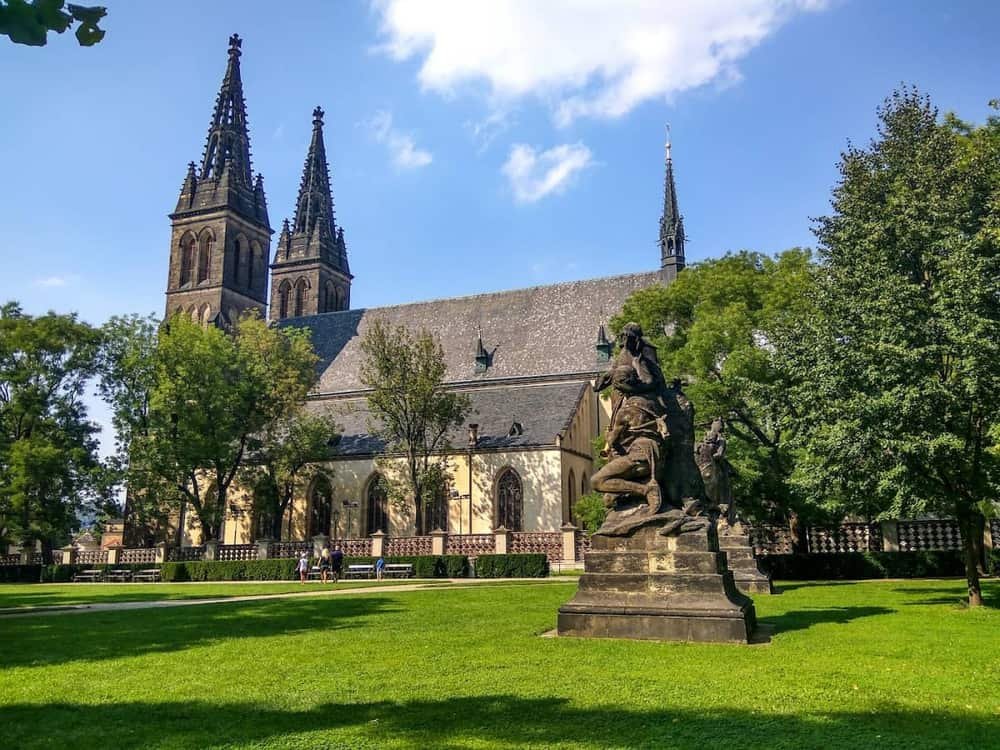
Vyšehrad is the free alternative to the Castle and, for many people, the better afternoon. The fortress grounds cost nothing to walk: the ramparts above the river, the view north towards the Castle, and the national cemetery where Dvořák, Smetana and Mucha are buried. It is quiet even in August.
Churches
Many of Prague's churches can be entered freely outside service times, or you can at least step into the entrance. The modernist Church of the Sacred Heart on Jiřího z Poděbrad is worth the tram ride for its architecture alone. Dress respectfully and keep quiet during services.
Along the river
Náplavka, the embankment below the Dancing House, is free to wander, and on Saturday mornings its farmers' market is a pleasure even if you buy nothing. Walk from there north along the river past the National Theatre at dusk, when the Castle lights come on across the water.
After dark
Prague at night is free and arguably better than Prague by day. The Castle and St. Vitus are floodlit above the river; the best place to see them is the Smetana embankment by the National Theatre, or from the middle of Charles Bridge once the day crowds have gone. The Old Town Square after ten, with the Týn towers lit and the square half empty, is a different place from the one at noon.
A note on free walking tours
The "free" walking tours advertised in the Old Town are tip-based: the guide is paid by what the group gives at the end. Many are good. Just go in knowing the custom, and give what the two hours were worth to you.
The things that nearly are free
A few of Prague's best experiences cost only a transport ticket. Tram 22 from the New Town to the Castle is a sightseeing ride in itself. The small public ferries across the Vltava use the ordinary ticket. And a 24-hour ticket also covers the Petřín funicular up to the orchards and the lookout area.
A free day in practice
Start on Charles Bridge at seven. Climb through Malá Strana to the Castle courtyards and the changing of the guard at noon. Walk down through the Wallenstein Garden and Kampa. Cross back to the Old Town for the square in the late afternoon, then take a tram to Vyšehrad for sunset on the ramparts. You will have seen most of what people pay tours to show them.
For the things that are worth paying for, the prices page lists what they cost, with the date each figure was checked.
Where to stay nearby
Live prices and availability on a map centred on this exact spot — hotels, apartments and hostels, so you can judge the walk from here rather than guess from an address.
Bookings made through this map earn us a commission. Your price is unaffected.